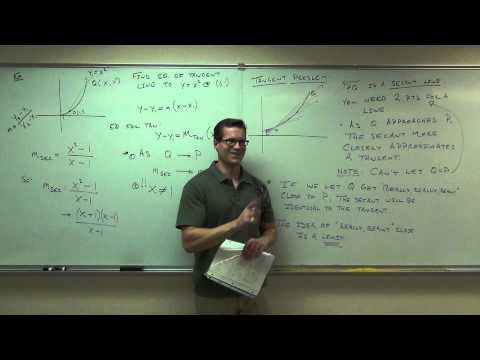
Mastering Limits: The Foundation of Calculus
From: Calculus 1 Lecture 1.1: An Introduction to Limits
In this intermediate interactive worksheet, you’ll learn the foundational idea of limits and practice using them as the basis for doing calculus. Thro...
Multiple Choice Questions
1. In the tangent-slope idea, why do we use a secant line instead of trying to compute the tangent slope directly at the single point?
2. As point Q approaches point P (without becoming equal), what happens to the secant line compared to the tangent line?
3. Why is it not allowed to set Q = P directly in the secant approach?
4. Which condition is necessary for the two-sided limit lim(x→a) f(x) to exist?
5. Suppose the limit from the right and from the left approach different values. What is the value of the two-sided limit?
6. In one-sided limit notation, what does the superscript '+' indicate?
7. A limit does NOT require the function to have a specific value at x = a. What does it focus on instead?
8. When computing a limit numerically with a table, what should you do to test the left-hand and right-hand behaviors?
9. If f(x) approaches +Infinity as x approaches a from both sides, which statement is correct?
10. In the example f(x) = 1/x as x approaches 0, what happens to the right-hand and left-hand limits?
Fill in the Blank
1. The core idea of a limit is to see what f(x) approaches as x gets really close to a value _____ (without necessarily reaching it).
2. A tangent line at a point can be found by taking the slope of secant lines as Q gets _____ to P (but never equals P).
3. For a two-sided limit lim(x→a) f(x) to exist, the left-hand limit and right-hand limit must approach the same _____ value.
4. In one-sided notation, a superscript _____ means approaching from the right.
5. In numerical limit tables, to find a two-sided limit you should evaluate f(x) at x-values close to a coming from both the _____ and the _____ sides.
Matching Exercise
Match each concept (left) to the correct description (right).
Column A
Column B
Video Reference
Interactive Transcript
Click timestamps to jump to specific moments in the video
Ready to check your answers?
Complete all the exercises above, then click the button to see how you did!
More from franchescareggiani
Discover more interactive workbooks and worksheets.